

)
)
)
)
)
)
)
)
)
)
)
)
)

)
)
)
)
)
08.10.2026
Immanuel Pherai: “We could not and would not accept that”
The Suriname international is back in Hamburg. During a press round, the 25-year-old midfielder spoke about his international trip, which was a positive one for him from a sporting perspective but was overshadowed towards the end by a racism scandal.
Since the summer of 2024, Immanuel Pherai has represented Suriname, his father’s homeland, at international level. The Amsterdam-born midfielder came through the Netherlands’ youth national teams and could also have represented a third country due to his Brazilian mother. Since making his debut, he has made 15 international appearances for the South American nation. Most recently, he travelled for the CONCACAF Nations League, featuring in matches against Honduras (2-3), Martinique (2-1) and Guatemala (0-0, 0-1), starting twice. He was also named in the starting line-up for the final match in Guatemala, before being substituted in the 94th minute, with Suriname conceding a late goal in the sixth minute of stoppage time to lose 1-0.
The defeat was not the only reason for Pherai’s unpleasant end to the international trip. More importantly, the circumstances surrounding the match left their mark: Suriname players were subjected to racist abuse during the game, including monkey noises, and after the final whistle a brawl broke out on the pitch. Speaking to the media in Hamburg on Thursday following his return, Pherai addressed what had happened.
“I have never experienced anything like it before. Considering the circumstances, it was the worst match of my career so far,” Pherai noted.
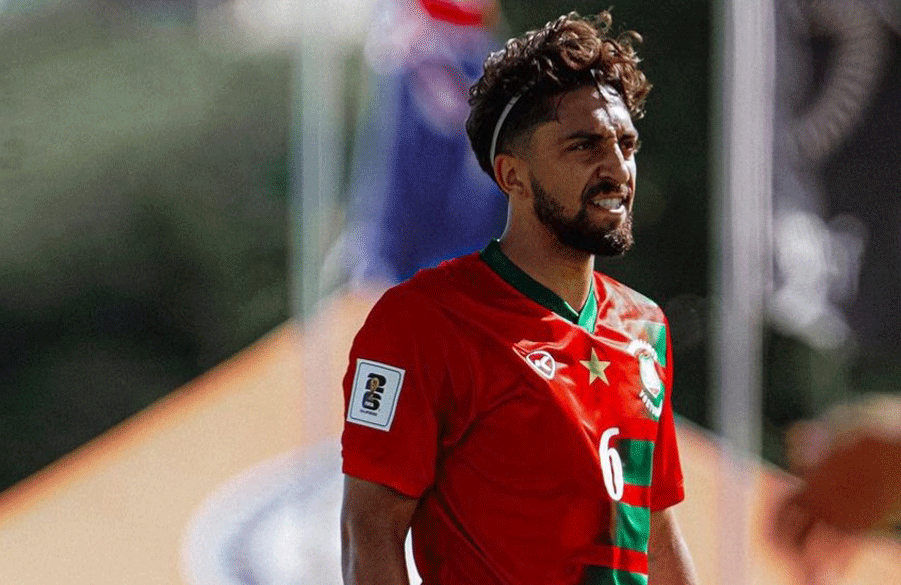
Archivfoto
The 25-year-old explained that the problems had already begun before kick-off: “There were already some incidents the day before the match. For example, we were not allowed to train at the stadium, and noise was deliberately made outside our hotel during the night before the game.”
For Pherai, however, those incidents, as well as the whistles during the pitch inspection, were still within what the team had expected. “But then the booing and heckling during our national anthem crossed the line into unsporting and disrespectful behaviour. Then, as soon as the match kicked off, it felt like 25,000 people were shouting ‘Negro, Negro, Negro’.”
The situation escalated further when Suriname striker Richonell Margaret was sent off in the 63rd minute. “Our player was shown a red card and then there was all sorts of abuse directed at him: insults, bottles being thrown, monkey noises. We could not and would not accept that as his teammates. We went over to the referee and told him that it was not okay.”
According to Pherai, the young referee had probably experienced a situation like this “for the first time” and consequently “did not quite have the game under control”.
“At the end, he was standing there on his own in a foreign country, and you could see that.”
Following the sending-off, tensions between the players on the pitch continued to rise, before the situation finally boiled over after the final whistle in a brawl.
“Everyone was involved in that situation. Of course, in a situation like that, you always have to think twice about your behaviour when emotions are running high. We could all have handled ourselves better, but I would never accept my teammates being attacked.
“I’m curious to see what will happen in the future when we meet again,” said Pherai, who is now pleased to be back in Hamburg and able to shift his focus back to football.
Advertisement